🍇
Fresh fruits delivered daily across Mumbai, Navi Mumbai & Thane
🌿
100% Chemical-free & naturally ripened daily produce
🚚
Next-day delivery slots available. WhatsApp us to confirm

Alphonso vs Kesar Mango

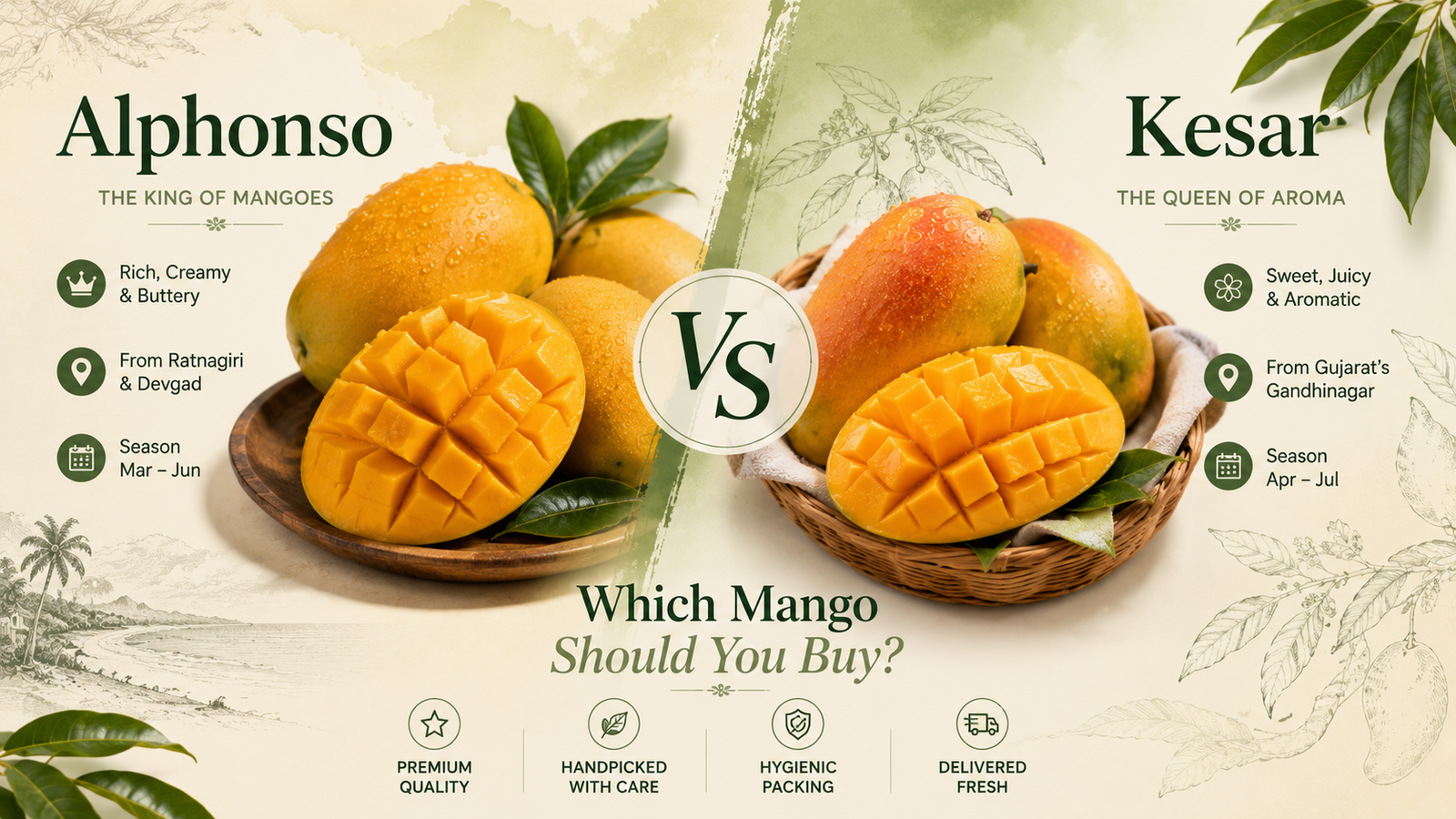
A deep comparison of India’s two most-loved premium mangoes — so you can choose the right one for your taste.
When mango season arrives, two names rise above all the rest in conversation, at the market and on the dinner table: Alphonso and Kesar. Both are premium mangoes, both inspire genuine devotion, and both have passionate fans ready to defend their favourite. Yet the two are surprisingly different — in where they grow, how they taste, how they feel and what they’re best used for. This article compares them in depth, so that whether you’re a lifelong mango lover or just beginning to explore India’s varieties, you can choose the one that suits you. Or, as many people happily do, enjoy both through the season.
Alphonso, the King of Mangoes
Alphonso — known affectionately across Maharashtra as Hapus — is often crowned the king of Indian mangoes, and it wears the title well. It’s grown chiefly in the coastal regions of Ratnagiri and Devgad in Maharashtra, where the particular soil, sea air and climate combine to produce a mango of exceptional character. The pulp is intensely rich and creamy, almost buttery, with virtually no fibre, a deep saffron-orange colour and a powerful, unmistakable aroma that fills a room. Alphonso has a relatively short season and, being labour-intensive to grow and much in demand, commands a premium price. That exclusivity is part of its mystique — for many, the arrival of the first Alphonsos is the true start of summer.
What Makes Alphonso Special
- A remarkably smooth, fibreless texture that almost melts on the tongue.
- Rich, creamy, dessert-like sweetness with deep complexity.
- A strong, heady aroma that’s instantly recognisable.
- A thin skin and a small stone, meaning more flesh per fruit.
- Prestige — it’s the classic choice for gifting and special occasions.
Kesar, the Saffron Mango
Kesar comes from Gujarat, most famously from the Junagadh and Gir regions at the foot of the Girnar hills. Its name comes from kesar, the word for saffron, a nod to its glowing golden-orange pulp. Kesar has a distinctive flavour — sweet and richly aromatic, but with a gentle tang that gives it a brighter, more refreshing edge than the pure richness of Alphonso. Its pulp is smooth but a touch firmer, which is precisely why it’s the mango of choice for aamras, milkshakes, ice creams and desserts, where it holds its character beautifully. Kesar’s season runs a little longer than Alphonso’s, and it usually costs slightly less, making it a wonderful everyday premium mango.
What Makes Kesar Special
- A sweet, aromatic flavour with a pleasant, refreshing tang.
- A smooth pulp that’s slightly firmer, holding up well in cooking and blending.
- A beautiful, saffron-like golden-orange colour.
- Excellent value for a premium mango.
- The go-to variety for aamras, shakes and desserts.
Side by Side
| Feature | Alphonso (Hapus) | Kesar |
| Main growing region | Ratnagiri & Devgad, Maharashtra | Junagadh & Gir, Gujarat |
| Flavour | Rich, creamy, buttery, complex | Sweet, aromatic, slightly tangy |
| Texture | Very smooth, completely fibreless | Smooth but a little firmer |
| Colour of pulp | Deep saffron-orange | Bright golden-orange |
| Aroma | Strong, heady, unmistakable | Fragrant and floral |
| Best used for | Eating fresh, premium gifting | Aamras, shakes, ice cream, desserts |
| Typical season | April to June (shorter) | April to July (slightly longer) |
| Price | Premium, the higher of the two | Premium, usually a little lower |
So Which Should You Choose?
The honest answer is that it depends entirely on what you want from your mango — and there’s no wrong choice between two fruits this good.
- Choose Alphonso if you want the ultimate fresh-eating experience, or a luxurious gift to impress. Its creamy richness and heady aroma are, for many, simply unmatched. This is the mango to eat slowly, on its own, and truly savour.
- Choose Kesar if you love aamras, mango shakes, kulfi and desserts, or if you prefer a sweeter mango with a refreshing tang. Its firmer pulp blends and cooks beautifully, and it offers wonderful value for the quality.
In practice, many mango lovers simply keep both at home through the season. They don’t really compete — they complement each other, one perfect for eating fresh and the other for turning into everything from aamras to ice cream.
How to Ripen and Store Either Variety
Both Alphonsos and Kesars are usually sold slightly firm so they survive the journey to you. Let them ripen naturally at room temperature, away from direct sunlight — a paper bag or a bed of hay or paper speeds things along nicely. They’re ready when they yield gently to a soft press near the stem and smell sweet and fragrant at the stem end. Once ripe, move them to the fridge to hold them for a few extra days, but bring them back to room temperature before eating to enjoy their full aroma and flavour.
| A Note on Authenticity Genuine Ratnagiri and Devgad Alphonsos, and true Gir Kesars, are prized for a reason. Because they command premium prices, lesser mangoes are sometimes passed off under their names. Buying from a trusted, transparent source is the best way to be sure you’re getting the real thing. |